An elite-level cutting board is the foundational workspace of any high-performance kitchen. Beyond simply providing a surface for prep, the right board acts as a “sacrificial” interface that protects the calibrated edges of your knives, ensures microbiological food safety, and provides the mechanical stability required for precision work. In this context, the debate around Bamboo vs Plastic Cutting Boards is becoming increasingly relevant.
In 2026, the marketplace for the best cutting boards for kitchens has converged on a primary debate: Bamboo vs Plastic Cutting Boards and Bamboo vs Plastic Cutting Boards. This guide provides a technical audit of both materials, evaluating their structural density, antimicrobial properties, and long-term ROI to help you select the optimal surface for your specific culinary workflow.
1. Quick Technical Audit: Performance Benchmarks
Before investing in a new set on Amazon, evaluate these mechanical benchmarks to see how each material handles the daily operational stress of a modern kitchen.
Bamboo vs Plastic Cutting Boards have unique attributes that cater to different cooking styles and preferences.
| Performance Metric | Bamboo (Compressed Fiber) | Plastic (High-Density Poly) |
| Material Density | High: 16% harder than Maple; highly warp-resistant. | Moderate: Prone to “furring” and deep scoring over time. |
| Microbiological Safety | Elite: Naturally antimicrobial; resists moisture absorption. | Good: Non-porous when new, but scars can trap bacteria. |
| Knife-Edge Impact | Aggressive: Hard surface requires more frequent sharpening. | Gentle: Softer landing for delicate high-carbon blades. |
| Sanitation Protocol | Manual: Hand-wash only; requires monthly oiling. | Industrial: 100% dishwasher safe at high temperatures. |
| Sustainability ROI | Excellent: Rapidly renewable; biodegradable. | Low: Petrochemical-based; contributes to microplastics. |
2. Engineering Overview: What is a Bamboo Cutting Board?
Bamboo cutting boards are engineered from compressed grass fibers bonded under high pressure. Because bamboo is a grass rather than a hardwood, it possesses a unique cellular structure that makes it one of the most durable and sustainable surfaces in the kitchen.
-
Structural Hardness: Bamboo’s density makes it incredibly resistant to “knife scarring.” This prevents deep grooves where bacteria typically thrive, making it a high-priority choice for hygiene-conscious kitchens.
Bamboo vs Plastic Cutting Boards offer distinct benefits that can enhance kitchen efficiency.
-
Moisture Resistance: Bamboo fibers are naturally hydrophobic, meaning they absorb less liquid than traditional wood. This reduces the risk of warping and “splitting” during standard use.
-
Aesthetic Utility: Beyond its performance, bamboo offers a “furniture-grade” finish that allows it to transition from a prep station to a serving board for charcuterie or hors d’oeuvres.
The discussion of Bamboo vs Plastic Cutting Boards often leads to considerations of environmental impact.
3. Operational Benefits of Bamboo Architecture
-
✔ Cross-Contamination Defense: Bamboo contains a natural bio-agent called “Bamboo Kun,” which helps resist the growth of bacteria on its surface.
-
✔ Dimensional Stability: Unlike thin plastic boards that can “slide” or “bow” on a damp counter, a high-quality bamboo block provides the mass and friction required for safe, high-torque chopping.
When selecting between Bamboo vs Plastic Cutting Boards, consider your cooking habits and maintenance preferences.
-
✔ Sustainable Procurement: As one of the fastest-growing plants on Earth, bamboo is the premier choice for reducing your household’s environmental footprint without sacrificing structural integrity.
-
✔ Odor Neutralization: The dense fiber structure prevents pungent volatile compounds (from garlic, onions, or fish) from penetrating the board, ensuring a neutral surface for your next prep task.
4. The “Practical Gear Lab” Buyer’s Checklist
When auditing a bamboo or plastic board on Amazon, look for these three technical markers of quality:
-
Grain Orientation: For bamboo, “vertical grain” or “end grain” is superior to “flat grain” for protecting your knife edges.
-
Adhesive Integrity: Ensure the board uses formaldehyde-free, food-safe glues (look for “Formaldehyde-Free” in the product specs).
-
Integrated Logistics: Prioritize boards with deep juice grooves and non-slip feet or “handle cutouts” to improve the safety and speed of your prep work.
Both Bamboo vs Plastic Cutting Boards can serve different roles in your kitchen setup.
Are you looking for a heavy-duty bamboo block to serve as a permanent, eco-friendly countertop anchor, or do you require the high-heat sanitation and lightweight utility of a professional plastic set?
Related Recommendations:
-
Best Bamboo Pick: Greener Chef Extra Large Bamboo Board (Eco-friendly, deep grooves).
-
Best Plastic Pick: OXO Good Grips Carving Board (Dishwasher safe, tapered handles).
Best Bamboo Cutting Boards on Amazon
For those in need of a versatile option, Bamboo vs Plastic Cutting Boards present varying functionalities.
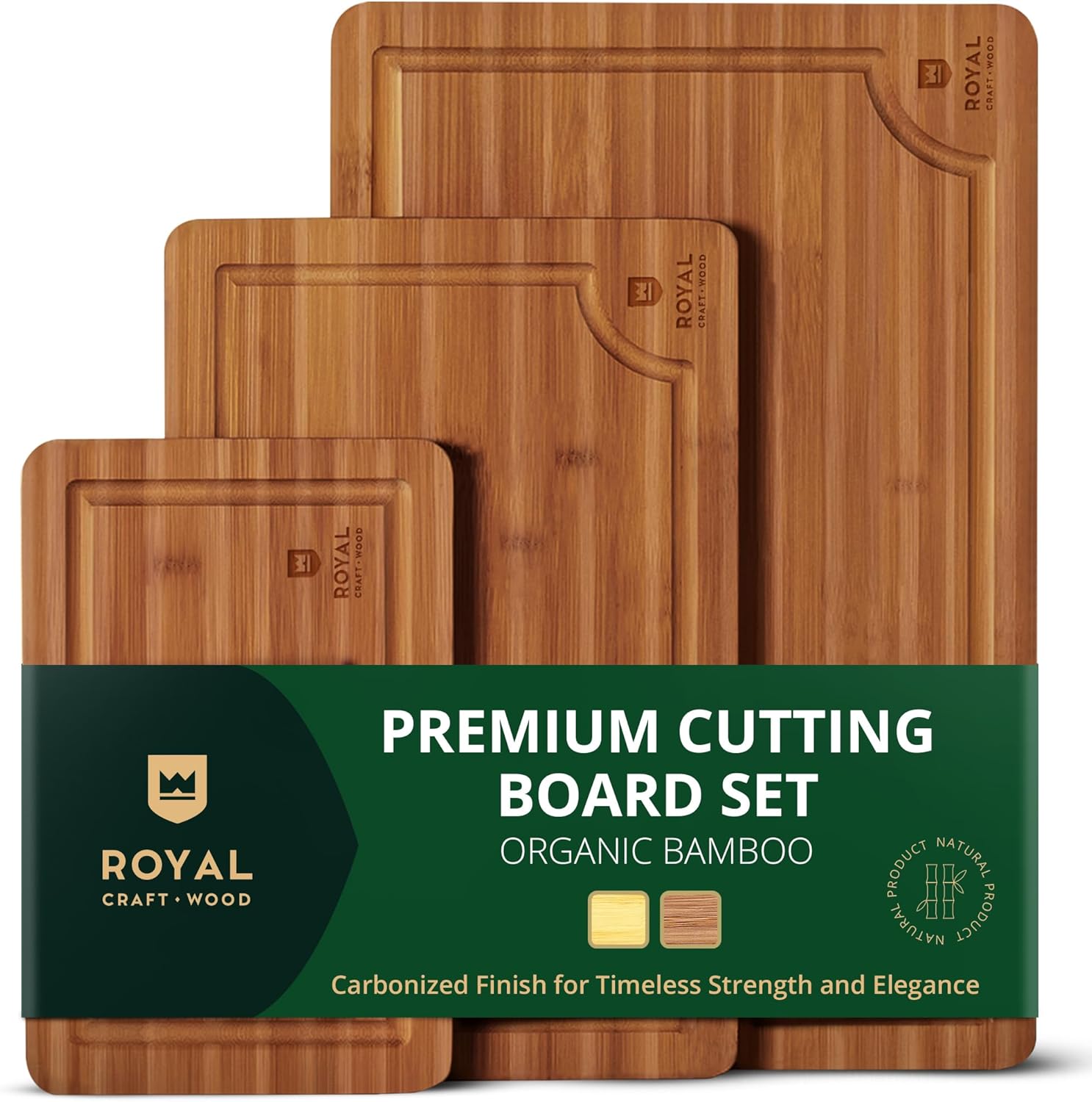
Royal Craft Wood Bamboo Cutting Board Set
Why It’s Popular
This set is widely recommended because it includes multiple sizes and has thousands of positive Amazon reviews.
Key features:
-
Set of three boards
-
Juice grooves for carving meats
When evaluating Bamboo vs Plastic Cutting Boards, consider how often you cook with raw meats.
-
Built-in side handles
-
Durable moso bamboo construction
Many home cooks appreciate how versatile the boards are for everything from vegetables to carving roasts.
Pros
-
Durable bamboo material
-
Multiple sizes
-
Attractive design
-
Good value for the price
Cons
-
Requires hand washing
-
Needs occasional oiling
In terms of durability, Bamboo vs Plastic Cutting Boards provide a comprehensive choice for home chefs.
Best For
-
Everyday meal prep
-
Families
-
People replacing plastic boards

Hiware Extra Large Bamboo Cutting Board
Why It Stands Out
This extra-large board gives you plenty of workspace and includes useful design features.
Features include:
-
Deep juice groove
-
Inner handles
-
Thick bamboo construction
-
Multi-purpose design
Many buyers also use it as a serving or charcuterie board.
Bamboo boards like this are praised for being durable and knife-friendly alternatives to plastic.
Pros
-
Large cutting surface
-
Long lifespan
-
Attractive natural look
Cons
-
Heavier than plastic boards
-
Requires proper care
Best For
-
Home cooks
The decision isn’t just about Bamboo vs Plastic Cutting Boards; it’s also about how they fit into your lifestyle.
-
Large meal prep
-
Kitchens that prefer natural materials
What Is a Plastic Cutting Board?
In many kitchens, the debate of bamboo vs plastic cutting boards continues to evolve.
Plastic cutting boards are typically made from polypropylene or polyethylene, both durable food-safe plastics. These boards are extremely common in homes and commercial kitchens.
Many people choose plastic boards because they are:
-
Lightweight
-
Affordable
-
Dishwasher safe
-
Easy to sanitize
They are especially common for raw meat preparation because they can be washed at high temperatures.
Best Plastic Cutting Boards on Amazon

OXO Good Grips Utility Cutting Board
Why Home Cooks Like It
OXO boards are known for their practical design and slip-resistant edges.
Features include:
-
Non-porous plastic surface
-
Juice groove edges
-
Non-slip corners
-
Dishwasher safe
Pros
-
Easy cleaning
-
Lightweight
-
Durable plastic construction
Cons
-
Knife marks develop over time
-
May retain odors
Best For
-
Raw meat prep
Ultimately, whether you choose Bamboo vs Plastic Cutting Boards can significantly impact your cooking experience.
-
Quick cleanup kitchens
-
Dishwasher users

Farberware Plastic Cutting Board Set
Why It’s a Budget Favorite
This set gives you several boards at an affordable price.
Key features:
-
Multiple board sizes
-
Polypropylene plastic
-
Non-porous surface
-
Dishwasher safe
Pros
-
Budget friendly
-
Lightweight
-
Easy storage
Cons
-
Scratches easily
-
Shorter lifespan than bamboo
Best For
-
Students
-
First apartments
-
Budget kitchens
For eco-conscious cooks, the debate of Bamboo vs Plastic Cutting Boards is particularly significant.
3. Comparative Performance: Structural & Material Benchmarks
Selecting between Bamboo vs. Plastic Cutting Boards involves balancing surface hardness with sanitation logistics. In a high-performance kitchen, the “material physics” of your board dictates how often you must sharpen your knives and how effectively you can mitigate cross-contamination.
The Performance Matrix
| Feature | Winner: Bamboo (Compressed Fiber) | Winner: Plastic (HDPE/Poly) |
| Material Density | High: 16% harder than Maple; extremely warp-resistant. | Moderate: Softer surface is prone to “furring” and deep scoring. |
| Microbiological Safety | Elite: Naturally antimicrobial; fibers “trap” and neutralize bacteria. | Good (New): Non-porous until heavily scarred by knife strikes. |
| Knife-Edge Impact | Aggressive: High silica content requires more frequent honing. | Gentle: Provides a “cushioned” landing for delicate blades. |
| Sanitation Protocol | Manual: Strictly hand-wash; requires monthly mineral oiling. | Industrial: 100% dishwasher safe at high temperatures. |
| Sustainability ROI | Excellent: Rapidly renewable grass; fully biodegradable. | Low: Petrochemical-based; contributes to microplastic waste. |
🛡️ The Hygiene Audit: Bacteria & Surface Integrity
In 2026, food safety experts prioritize Surface Planarity. A board is only as safe as its ability to be cleaned.
-
Bamboo Boards: Feature a dense, hydrophobic cell structure. While they cannot go in the dishwasher, studies suggest that natural capillary action pulls bacteria into the lower fibers where they die off. However, they require Active Maintenance (oiling) to prevent the small cracks where moisture could linger.
-
Plastic Boards: Offer the highest level of Sanitation Velocity. Being able to cycle a board through a high-heat dishwasher is the most reliable way to kill pathogens after prepping raw proteins. Note: Once a plastic board is heavily “furred” with white plastic shreds, it should be retired, as those grooves are nearly impossible to sanitize manually.
👨🍳 The “Point-of-Origin” Sorting Strategy
Professional home cooks rarely rely on a single material. A Strategic Hybrid Inventory is the most efficient way to manage your kitchen logistics:
-
The Primary Prep Station (Bamboo): Deploy a large Bamboo Block for all “clean” prep—vegetables, aromatics, fruits, and bread. Its mass provides the stability needed for precision dicing and high-volume chopping.
-
The Protein Specialist (Plastic): Keep a set of Thin, Color-Coded Plastic Boards specifically for raw poultry, fish, and red meat. These can be moved directly from the counter to the dishwasher, ensuring zero cross-contamination.
Choosing between Bamboo vs Plastic Cutting Boards often reflects your kitchen philosophy.
🛠️ Operational Protocol: Extending Lifecycle
For Bamboo Longevity
-
Hydration Cycle: Apply food-grade mineral oil once a month. This creates a “hydrophobic barrier,” preventing juices from soaking into the fibers and stopping the wood from drying out and splitting.
-
The “Vertical Dry” Rule: Always store bamboo boards upright after washing. Airflow on both sides prevents the uneven expansion that causes warping.
For Plastic Longevity
-
Surface Refacing: If a high-quality plastic board becomes lightly scarred, it can occasionally be sanded down to a smooth finish. If it is a budget board, replace it annually.
-
Heat Management: Avoid using plastic boards as “trivets” for hot pans; extreme heat can cause permanent warping and chemical breakdown of the polymer.
Understanding the differences in Bamboo vs Plastic Cutting Boards can enhance your culinary skills.
🏆 2026 Cutting Board Leaderboard: Top Amazon Picks
| Category | Top Recommendation | Technical “X-Factor” |
| 🥇 Best Overall Bamboo | Greener Chef Organic Set | Formaldehyde-free adhesives; deep perimeter juice grooves. |
| 🥈 Best Overall Plastic | OXO Good Grips Carving Board | Non-slip tapered edges; high-capacity reservoirs for liquids. |
| 🥉 Best Value Set | Royal Craft Wood 3-Piece | Multi-size nesting for diverse prep tasks; sustainable sourcing. |
| 📦 Best for Small Spaces | Gorilla Grip Reversible Set | Lightweight, easy-store profile with superior grip. |
Final Verdict: Which Fits Your Workflow?
The comparison of Bamboo vs Plastic Cutting Boards is crucial for anyone looking to optimize their kitchen.
The choice between Bamboo vs. Plastic is a trade-off between durability and convenience.
-
Invest in Bamboo if you want a sustainable, antimicrobial, and aesthetically superior surface that serves as a permanent kitchen anchor.
-
Invest in Plastic if you prioritize high-heat sanitation and a lightweight, budget-friendly solution for raw meat prep.
Are you looking for a heavy-duty bamboo block to act as your primary vegetable prep station, or do you need a set of dishwasher-safe plastic boards to streamline your raw protein handling?
Ultimately, your choice in Bamboo vs Plastic Cutting Boards will define your cooking experience.


)